

Article: A century later, Hamilton returns to the Cushion
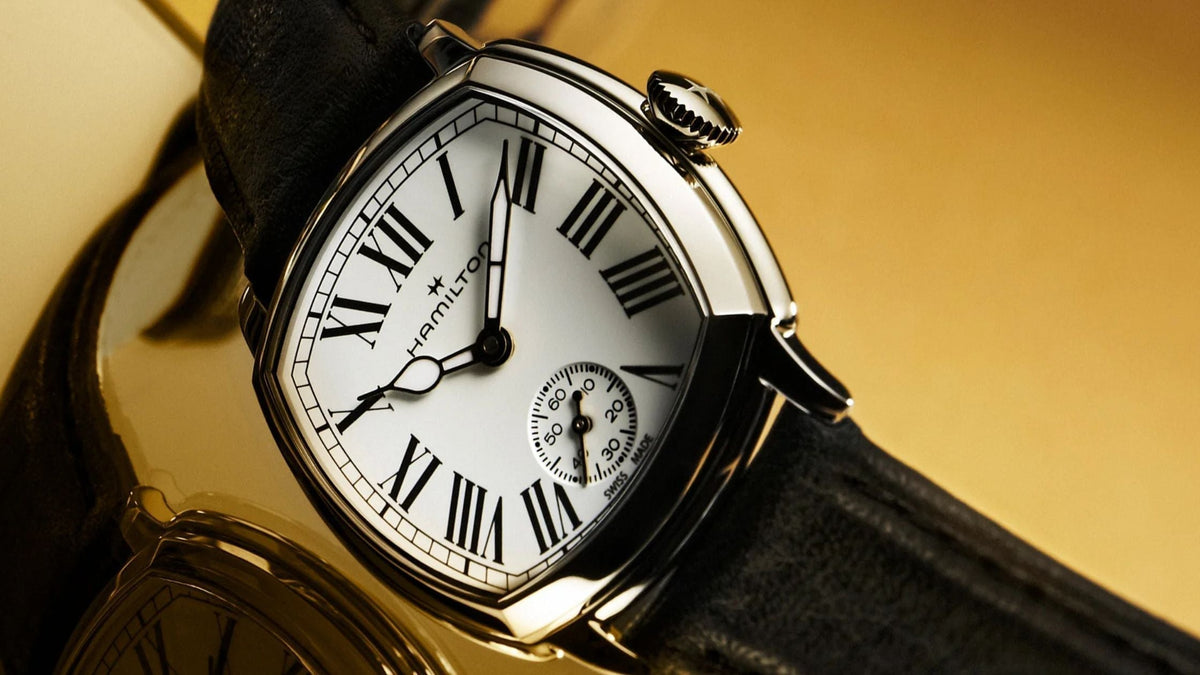
A century later, Hamilton returns to the Cushion
Hamilton’s new American Classic Cushion brings one of its earliest wristwatch designs back into the collection, with original proportions, a hand-wound movement and a history that recently reached the cinema.
Today, a cushion case, which is essentially a square with softened sides, sits alongside the familiar round, rectangular and tonneau forms. In the early 20th century, however, the wristwatch itself was still finding its identity and Hamilton was there while that was happening.
The new American Classic Cushion reaches back to that formative period. More specifically, it revisits a design introduced in 1926, when Hamilton was creating some of the most distinctive American wristwatches of the Art Deco era.

When the wristwatch was still new
Hamilton’s wristwatches appeared in 1919. Like many watches from this transitional period, they used small movements originally developed for other applications and placed them inside cases designed to sit on a strap. And one of those shapes was the cushion.
Hamilton formally announced its Cushion in 1922. The name was refreshingly literal: its rounded-square case resembled the outline of a seat cushion. It belonged to a wider generation of Hamilton watches identified by their geometry, alongside models with names such as the Square, Oval and Rectangular.
As wristwatches became more established, the design developed.
Hamilton moved to smaller movements during the 1920s, allowing its cases to become more refined. By 1926, the Cushion had acquired the proportions and architectural details that have informed the new American Classic collection.
The Cushion B followed in 1931, returning to a round dial opening within the softened-square case. Hamilton continued producing variations of the design into the 1930s, with its final original cushion watches appearing during the Second World War.
Hamilton has created other cushion-shaped watches since, including the larger Pan Europ and the digital PSR. What it has not done is bring this early family of small, hand-wound American watches directly back into its modern collection.
Until now.

The 1926 design, without the 1926 compromises
The American Classic Cushion is available in two sizes: 30mm by 30mm and 34mm by 34mm.
Those measurements sound small if they are judged by the conventions of a round watch. A square case occupies more space across the wrist, however, and its corners give it greater visual presence than the equivalent circular diameter would suggest.
Hamilton could have enlarged the Cushion to 38mm or 40mm and described the result as a modern interpretation. Instead, the brand has allowed it to look like the type of watch it is based upon.
Both sizes are just 8.1mm thick. The 30mm case measures 34mm from lug to lug, while the 34mm version measures 38mm. That keeps the profile compact and allows the watch to sit close to the wrist.
There are six references altogether, spanning stainless steel and yellow-gold PVD cases. Some use smooth polished bezels, while the engraved 34mm version makes a more direct feature of the geometric decoration found on Hamilton’s original cases.
The dial options include crisp Roman numerals, stylised Arabic numerals, railway minute tracks and a choice of white, beige, silver and black finishes.

H-42: A new hand-wound movement
Inside is Hamilton’s new H-42 mechanical movement.
The calibre is based on the ETA 7001, itself descended from the slim Peseux 7001 introduced during the 1970s. Its architecture makes it particularly well suited to a watch like this: compact, manually wound and built around a small-seconds display at six.
Hamilton has updated it with the Nivachron balance spring which, if you don't know already, reduces the effects of everyday magnetic fields, temperature changes and shocks. The power reserve has also been extended to 57 hours.
And choosing a hand-wound movement was more than a historical gesture. Without an automatic winding rotor sitting above the calibre, Hamilton has been able to keep the complete watch remarkably thin. It also preserves the interaction that defined the original Cushion: the watch is powered by winding its crown rather than by movement of the wrist.
The mechanism can be viewed through a sapphire exhibition caseback, something the original owners in the 1920s didn't have the pleasure of getting.
Modern practicality continues with an anti-reflective sapphire crystal, 50 metres of water resistance, Super-LumiNova and quick-release leather straps.

The Cushion’s unexpected return in Oppenheimer
The new American Classic Cushion is not an Oppenheimer edition, but the film forms an interesting part of the story.
Christopher Nolan and his production team wanted the watches in Oppenheimer to be appropriate not only to the period, but also to the individuals wearing them. Hamilton therefore helped source six genuine vintage watches from private collectors rather than supplying modern pieces that merely looked old.
Three were worn by Cillian Murphy as J. Robert Oppenheimer: a Cushion, an Endicott and a Lexington. The watches were not treated as conspicuous product placements and often appeared only briefly beneath a shirt cuff, becasue their purpose was to help establish period and character.
Hamilton went to its collector network to find an original Cushion for the screen, and only three years later, it has returned to the same chapter of its history to create a Cushion that can be bought new.

Why this release matters
Hamilton has no shortage of history to revisit. Its military watches, early aviation instruments, pioneering electric movements and relationship with cinema have already inspired some of the company’s best-known modern releases.
The Cushion reaches further back, coming from a period when the wristwatch was moving away from being a modified pocket watch and developing its own proportions, shapes and design language. The rounded-square case, compact dimensions and small seconds were not retro details at the time. They were part of a new way of wearing a watch.
The collection is also a reminder that historical accuracy does not always require an artificially aged dial or an obvious reference to the past. Sometimes it means resisting the temptation to modernise the most important details.
A century after the design that inspired it, the Cushion looks unusual again.
That's probably the best reason to bring it back.
The Hamilton American Classic Cushion Mechanical collection is available now at WatchNation, from £935, with yellow-gold PVD models priced at £1,040.
```


Leave a comment
This site is protected by hCaptcha and the hCaptcha Privacy Policy and Terms of Service apply.