Article: Hamilton: What Is a Nivachron Balance Spring?
Hamilton: What Is a Nivachron Balance Spring?
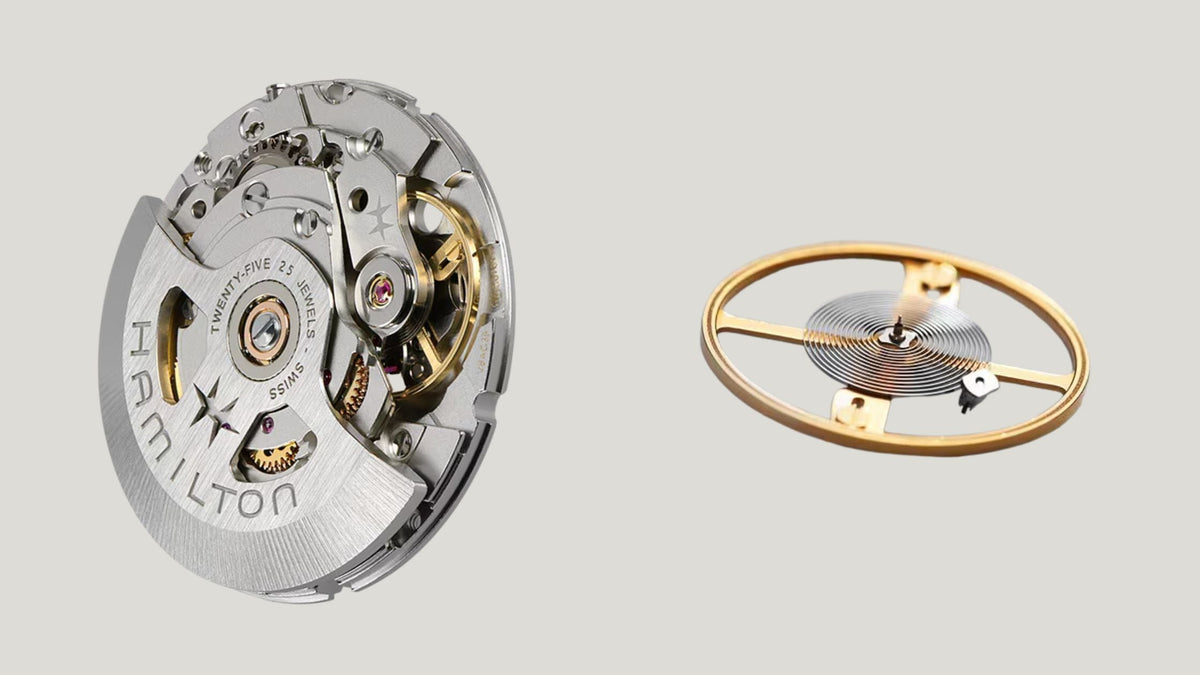
One of the most important upgrades inside a modern Hamilton watch is also one of the smallest. The balance spring is a fine coil of metal hidden within the movement. Together with the balance wheel, it regulates the rate at which a mechanical watch runs. If its behaviour changes, the timekeeping changes with it. That makes the balance spring particularly important, and particularly vulnerable.
Magnetic fields, temperature changes and physical shocks can all disturb a conventional balance spring. Nivachron was developed to make this critical component considerably more resistant to those everyday influences.

What is a balance spring in a watch?
The balance spring, also commonly called the hairspring, is a very fine spiral spring attached to the balance wheel inside a mechanical movement. The balance wheel rotates backwards and forwards while the spring repeatedly contracts and expands. These precisely controlled oscillations divide time into equal intervals, allowing the movement to release its stored energy at a consistent rate. It is often described as the heartbeat of a mechanical watch. That description is useful, but the balance is really closer to the watch’s regulator.
The mainspring supplies the energy. The gear train transfers it. The escapement releases it. The balance wheel and balance spring determine the rate at which that process takes place. A change in the behaviour of the balance spring can therefore cause the watch to gain time, lose time or, in more serious cases, stop.

What is Nivachron?
Nivachron is a Swiss-made, titanium-based alloy developed specifically for the production of balance springs.
It was announced by the Swatch Group in 2018 after being developed in collaboration with Audemars Piguet. The first watch to use it was the Swatch Flymagic in 2019, before the technology began appearing more widely across the group’s mechanical movements. Hamilton started introducing Nivachron balance springs into its watches in 2020.
Its primary purpose is to reduce the effect of magnetic fields on the regulation of a mechanical movement. However, the alloy was also developed to perform consistently through changes in temperature and to offer strong resistance to shocks. Nivachron does not add another function to the watch. There is no additional display, button or complication. Instead, it improves the stability of the component responsible for keeping time.

Why is magnetism a problem for mechanical watches?
Magnetic fields are part of modern life. They can be produced by speakers, electronic devices, magnetic fasteners and numerous other objects encountered throughout the day. Most brief or distant exposure will not automatically cause a problem, but a sufficiently strong field can influence the metal components inside a mechanical movement. The balance spring is particularly sensitive because it is extremely fine and relies on maintaining a precise shape and elasticity.
If a conventional balance spring becomes magnetised, its coils can begin to attract one another. This changes the effective length of the spring and interferes with the oscillation of the balance wheel. A watch affected in this way will often begin running noticeably fast, although the exact symptoms depend on the movement and the level of exposure. In more significant cases, magnetism can disrupt the movement enough to stop it.
The problem is not necessarily permanent. A watchmaker can usually test and demagnetise an affected movement relatively quickly. Nivachron is designed to make that intervention much less likely to be needed.

How does Nivachron resist magnetism?
Nivachron does not surround the movement with a protective inner case or attempt to redirect a magnetic field around the watch. The resistance comes from the material used to make the balance spring itself.
Its titanium-based composition is considerably less susceptible to magnetic influence than the traditional metallic alloys used for many balance springs. This allows the spring to retain more consistent regulating properties when the watch encounters a magnetic field.
Nivachron reduces the residual effect of magnetism on the running of a watch by a factor of between 10 and 20, depending on the calibre. It does not necessarily mean the entire watch can withstand a magnetic field 20 times stronger. It means that the remaining influence on its rate can be reduced by that factor after exposure, with the result depending on the construction of the individual movement.

Does Nivachron improve accuracy?
Nivachron can improve chronometric performance, but it does not automatically make every watch accurate to the same figure. Its advantage is consistency.
By reducing the effects of magnetism, temperature variation and shock on the balance spring, Nivachron helps the movement maintain its regulated rate under changing conditions. The final accuracy of a mechanical watch still depends on several factors, including the design of the calibre, how it has been regulated, its position, its state of wind and how it is worn.
A Nivachron balance spring is not the same as an accuracy certification, nor does its presence mean a watch has been tested to chronometer standards. What it provides is a more stable foundation for accurate timekeeping.
What does temperature have to do with a balance spring?
The elasticity of a metal can change as its temperature changes. In a balance spring, even a small variation can influence how quickly the balance wheel oscillates. Watchmakers have spent centuries developing materials and constructions that compensate for this effect. Nivachron is described as a compensating alloy because it is engineered to remain stable across the temperature variations a watch is likely to experience while being worn.
That does not mean it is designed for unlimited extremes. It means that normal changes in temperature should have less influence on the regulating organ than they might have on a less advanced spring. For the wearer, the benefit is once again greater consistency rather than a new feature that needs to be operated.
Is Nivachron better than a conventional balance spring?
For resistance to magnetism, temperature variation and shock, Nivachron offers clear advantages over a standard metallic balance spring. That does not mean traditional balance-spring alloys are inherently poor. Modern mechanical watches have used carefully developed compensating alloys successfully for decades.
Nivachron responds to a world in which watches are routinely worn around more electronic equipment and magnetic objects than their predecessors were likely to encounter. The improvement is not obvious from the outside, but it addresses a genuine practical weakness within mechanical watchmaking.
Which Hamilton watches use Nivachron?
Hamilton now uses Nivachron across several of its mechanical movements, from three-hand automatics to GMTs and chronographs.
The clearest way to understand where it appears is by movement rather than collection, as one Hamilton family can contain several different calibres.
H-10
Hamilton’s principal three-hand automatic movement combines a Nivachron balance spring with an 80-hour power reserve.
It is used in current models including the Khaki Field Automatic, Khaki Field Murph, Khaki Field Expedition, Khaki Navy Scuba Automatic, Jazzmaster Open Heart, Jazzmaster Performer Automatic and selected American Classic watches, including the Spirit of Liberty.
H-10-S
The H-10-S is the skeletonised version of the H-10, retaining its 80-hour power reserve and Nivachron balance spring while opening the movement for display.
It appears in the Jazzmaster Skeleton, Jazzmaster Viewmatic Skeleton and skeletonised Ventura models, including the Ventura Edge Skeleton.
H-14
The H-14 adds an independently adjustable GMT hand to Hamilton’s 80-hour automatic platform.
It is currently used in the Khaki Navy Scuba Auto GMT, where Nivachron supports a movement designed for travel as well as diving.
H-30
The H-30 is an 80-hour automatic movement with both day and date displays.
It can be found in the Khaki Aviation Pilot Day Date, Khaki Aviation X-Wind Day Date, selected Khaki Field Day Date models and the American Classic Pan Europ Day Date.
H-31
Hamilton’s H-31 is an automatic chronograph movement with approximately 60 hours of power reserve.
Nivachron-equipped versions have appeared in the American Classic Intra-Matic Auto Chronograph, Chrono-Matic 50 and Jazzmaster Performer Auto Chronograph.
H-40
The H-40 combines automatic winding, an 80-hour power reserve and a day-date display.
Its best-known current application is the Khaki Field King, although it can also be found in selected generations of the Khaki Aviation Pilot Day Date.
H-42
Introduced for the American Classic Cushion, the H-42 is a slim hand-wound movement based on the ETA 7001.
Its Nivachron balance spring and 57-hour power reserve allow Hamilton to place modern movement technology inside the compact 30mm and 34mm cushion-shaped cases.
H-50
The hand-wound H-50 provides 80 hours of power reserve and is closely associated with Hamilton’s military-inspired watches.
It powers the Khaki Field Mechanical, including the 36mm, 38mm, 42mm and bronze versions, as well as the Khaki Aviation Pilot Pioneer Mechanical.
H-51
The H-51 is Hamilton’s hand-wound chronograph movement, offering a 60-hour power reserve alongside its Nivachron balance spring.
It is used in the American Classic Intra-Matic Chronograph H, combining modern magnetic resistance with the traditional interaction of a manually wound chronograph.

Can you see the Nivachron balance spring?
In most watches, not easily. Even where a watch has an exhibition caseback, the balance spring is a very small component positioned beneath or alongside the balance wheel. Parts of the regulating assembly may be visible while the movement is running, but the material itself is unlikely to look obviously different without close magnification.
Skeleton and Openwork watches provide the clearest opportunity to observe the balance oscillating, although the primary value of Nivachron remains functional rather than visual. It is one of those watchmaking upgrades that matters precisely because you do not normally have to think about it.
Can a watch with Nivachron still become magnetised?
It is possible for other components within the movement to be influenced by a strong magnetic field, even if the balance spring itself is highly resistant. If a mechanical watch suddenly begins gaining or losing a significant amount of time, magnetism is one possible cause. A knock, a low power reserve or a developing service issue can produce similar symptoms.
Allow the watch to run through a normal day and compare it against a reliable time source. If the change is substantial or continues consistently, an authorised retailer or watchmaker can test the movement. Demagnetisation is normally straightforward, but diagnosing the cause first avoids treating every change in rate as the same problem.
Does Nivachron need any special maintenance?
No additional maintenance is required simply because a watch contains a Nivachron balance spring. The movement should be cared for and serviced in the same way as any other mechanical watch. Service intervals depend on the calibre, how the watch is worn and the conditions it encounters.
Nivachron improves resistance to several external influences, but it does not prevent lubricants from ageing or remove the need for the movement to be inspected over time.

Why does Nivachron matter?
Mechanical watches are valued partly because their timekeeping is created through the interaction of tiny physical components.
Nivachron does not attempt to turn a mechanical watch into a quartz watch, nor does it remove all of the variation that comes with mechanical timekeeping. It makes one of the movement’s most critical components less vulnerable to magnetism, shocks and temperature changes. The technology is modern, but the objective is traditional: helping a mechanical watch maintain a stable and dependable rate. For Hamilton, it means watches inspired by historic field, aviation and dress designs can contain a regulating component developed for the conditions in which they are worn today.