

Articolo: Victorinox Maverick 39mm: Smaller Case, More Features
Victorinox Maverick 39mm: Smaller Case, More Features
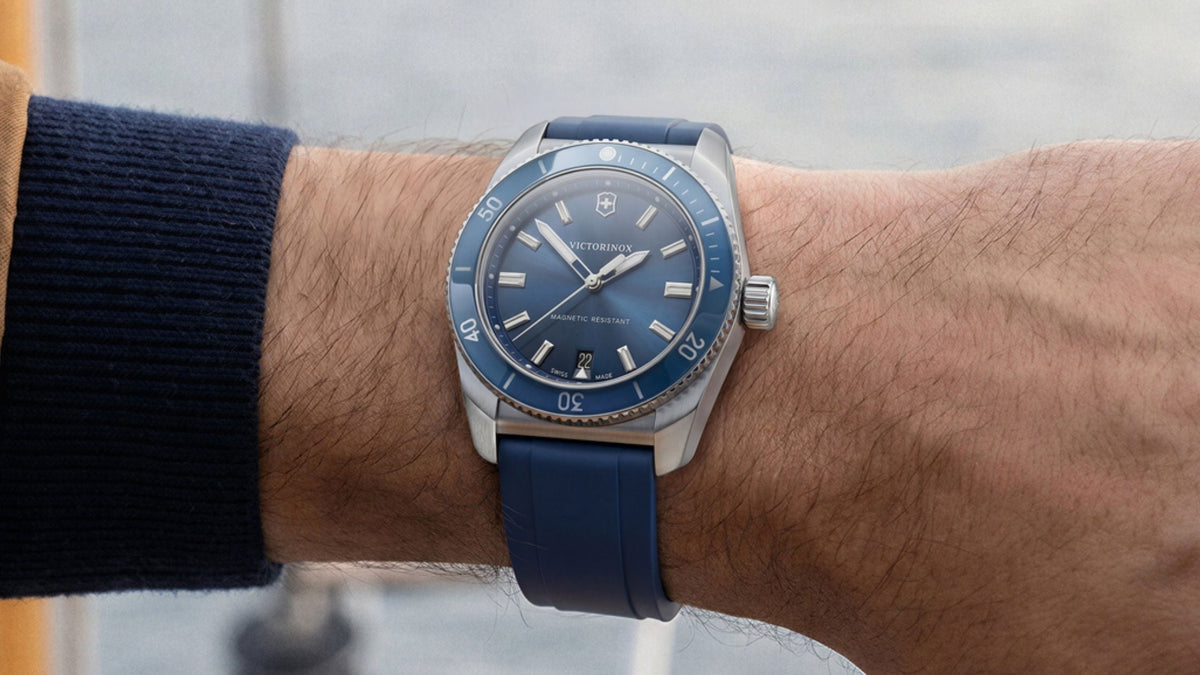
The Victorinox Maverick has been around for roughly two decades, usually occupying an interesting middle ground between dive watch and everyday sports watch. It has the rotating bezel, luminous dial and robust construction you would expect from something designed around the water, but it has traditionally been a little more polished than a pure tool watch.
For 2026, Victorinox has gone back to that formula rather than simply adding another dial colour. The familiar 43mm case has been replaced by a 39mm format, water resistance has increased from 100 to 200 metres, double anti-shock protection has been added, and every model now uses a tool-free interchangeable strap or bracelet system. The collection also launches with both quartz and automatic movements, giving the Maverick a clearer structure than it has had for some time. Victorinox itself describes the new watch as a return of the Maverick “two decades after its initial success”, but the specification suggests this is more redesign than reissue.


From 43mm to 39mm
The outgoing Maverick Large measures 43mm across, with a substantial steel case, broad rotating bezel and 21mm bracelet. It is not enormous by sports-watch standards, but there has never been anything particularly discreet about it either. The new Maverick brings the diameter down by four millimetres without changing the basic character of the watch.
That matters because 39mm is not simply “smaller”. On a watch with a timing bezel, crown protection and strongly defined hour markers, there is already plenty of visual information occupying the wrist. The Maverick does not need another four millimetres of dial simply to have presence, and the new proportions should make it considerably easier to wear across a wider range of wrists.
More importantly, Victorinox has resisted the usual compromise that sometimes accompanies downsizing a sports watch. The previous 43mm Maverick Large offered 100 metres of water resistance; the new 39mm range doubles that to 200 metres. The sapphire crystal remains, the bezel is still functional, and the watches gain double anti-shock protection. In other words, the new Maverick asks for less room on the wrist while becoming more capable underneath.

Quartz and automatic from the start
There are 14 references in the initial range, divided into ten quartz watches and four automatics.
The quartz models use the Swiss-made Ronda 715, while the automatic watches are powered by the Sellita SW200. Both share the same 39mm foundation, 200m water resistance and double anti-shock protection, but Victorinox has made enough changes between them that the automatic does not feel like the same watch with a more expensive movement dropped inside.
Quartz models use a high-polished mineral bezel insert and add magnetic resistance, something Victorinox specifically highlights as part of their everyday durability. The automatic versions move to a ceramic bezel insert, while the mechanical movement becomes visible from the back of the watch.
The dimensions stay impressively close. The quartz Maverick is approximately 11.3mm thick, while the automatic is around 11.8mm, so choosing the mechanical movement adds very little bulk.
That is useful because the Maverick has never really been about the movement alone. It is a practical sports watch first, and both versions make a fairly convincing argument depending on what you want from it.

The quartz Maverick makes plenty of sense
There can be a tendency to treat the quartz version of a watch as the one you buy before stepping up to the automatic. That does the new Maverick a disservice.
The Ronda 715 is a straightforward Swiss quartz calibre with hours, minutes, seconds and date. There is no winding or power reserve to think about, and the watch will generally be ready whenever it is picked up. Victorinox then adds the 200m water resistance, sapphire crystal, double anti-shock construction and magnetic resistance around it. The brand explicitly positions that protection as useful in the kinds of electronic and magnetic environments a modern watch encounters every day.
It is also the quartz side of the collection where Victorinox has taken more chances with colour. Alongside familiar black, blue and green are a red dial, rubber-strap options and several silver-and-yellow-gold combinations, including an ice-blue bezel treatment. The ten references give the quartz range considerably more variety than a typical entry point into a collection.
That range suits the movement. If the appeal of the Maverick is a capable watch that requires very little attention, quartz is hardly the consolation prize.

The automatic takes a more focused approach
The automatic collection is smaller: black on rubber, followed by black, blue and green versions on stainless-steel bracelets. Each uses a ceramic bezel insert rather than the polished mineral treatment of the quartz watches.
Inside is the Sellita SW200, one of the more familiar Swiss automatic movements used across modern watchmaking. It offers manual winding and stop-seconds alongside automatic winding, while Victorinox's technical material quotes approximately 38 hours of power reserve for the Maverick.
The choice is a sensible one. The SW200 is established and widely understood, which feels appropriate for a watch being sold on practical dependability rather than movement novelty. Victorinox also gives the automatic a display caseback, allowing the mechanical side of the watch to remain visible without changing the relatively straightforward layout on the front.
The ceramic bezel is arguably just as important to the distinction. It gives the automatic version a tangible material upgrade rather than asking the movement to justify the entire difference by itself.

More Victorinox in the details
Victorinox talks heavily about the Maverick being inspired by its Swiss Army Knife heritage, but the better connections are the practical ones rather than simply putting more red shields around the watch.
The clearest example is the tool-free interchangeable strap and bracelet system, fitted across the entire new collection. It allows the bracelet or rubber strap to be removed without a spring-bar tool, making the watch genuinely easier to change around rather than merely describing it as versatile.
The same thinking appears in the double anti-shock construction. Victorinox has increasingly made protection against shock and magnetism part of its contemporary watch offering, positioning durability as something engineered into the watch rather than something communicated through an oversized case. On the new Maverick, that feels particularly appropriate: reducing the diameter while increasing the protection makes a stronger argument for toughness than simply adding more steel would have done.
The design has also become a little more considered. Applied markers use polished and sandblasted surfaces to remain visible as the light changes, while luminescent material appears on the dial, hands and bezel. The case mixes brushed and polished finishing rather than committing fully to the utilitarian side of the sports-watch formula.
That balance has always been part of the Maverick. It looks capable without needing to look purely functional.

Is it a dive watch?
The Maverick has always sat slightly between categories.
It has the familiar visual language of a dive watch — rotating bezel, luminous markers, strong crown protection and a steel sports-watch case — and the new 200m water-resistance rating gives that appearance more technical substance than before. Victorinox itself has variously described previous Mavericks as diving or diving-inspired watches, and its live press material for the 2026 model continues to emphasise the rotating bezel and high water resistance.
I would still think of it as a versatile sports watch with strong dive-watch influence rather than reducing it entirely to one category. That is partly what makes the Maverick useful: its design makes sense around water, but it has never been so specialised that it feels odd away from it.
The new dimensions reinforce that. A 39mm case under 12mm thick is much easier to treat as an everyday watch than a large purpose-built diver, even though the depth rating has moved in the opposite direction.
Fourteen versions, one clearer Maverick
Fourteen watches sounds like a complicated launch until the structure is stripped back.
Every new Maverick starts with the same basic idea: 39mm stainless-steel case, sapphire crystal, 200 metres of water resistance, date display, double anti-shock protection and tool-free strap compatibility. From there, the choice is between quartz or automatic, bracelet or rubber, and then colour and finish.
That makes the collection considerably easier to understand than a range spread across different case sizes, chronographs and movement types. The quartz side provides the widest choice and lowest-maintenance ownership; the automatic side adds the SW200, ceramic bezel and visible mechanical movement.

A smaller Maverick, properly reworked
The easiest thing Victorinox could have done was reduce the existing Maverick from 43mm to 39mm and call the job finished.
Instead, the 2026 version uses the smaller case as part of a broader rethink. Water resistance has doubled, the automatic has returned as a central part of the collection, movement protection has become more prominent and the interchangeable strap system makes the versatility Victorinox talks about genuinely useful.
The Maverick remains recognisable. There is still a strong bezel, clear dial, substantial crown protection and the mix of sporty and polished detailing that has defined the collection for years.
It is simply packaged more intelligently now.
At 39mm, the Maverick asks for less space on the wrist while giving very little away anywhere else.


Commenta
Questo sito è protetto da hCaptcha e applica le Norme sulla privacy e i Termini di servizio di hCaptcha.