The History of Orient: Over 75 Years of Japanese Watchmaking
Orient has been making mechanical watches for more than 75 years, but it has rarely done it in only one way. There have been slim automatic dress watches and 1,000-metre divers. Watches with 100 jewels, watches illuminated by miniature bulbs and one that displayed the time when you touched the case. Orient even built a limited-edition watch containing three separate automatic movements.
Alongside them came the ideas that are much more familiar today. The Multi-Year Calendar dates back to the 1960s. The movement family behind many modern Orient watches began in 1971. M-Force arrived in the 1990s, followed by the Mako in 2004 and the watch that would become known as the Bambino in 2012. That mix of practical watchmaking and slightly unusual thinking is a big part of what makes Orient, Orient.

1950s: The Orient Story Begins
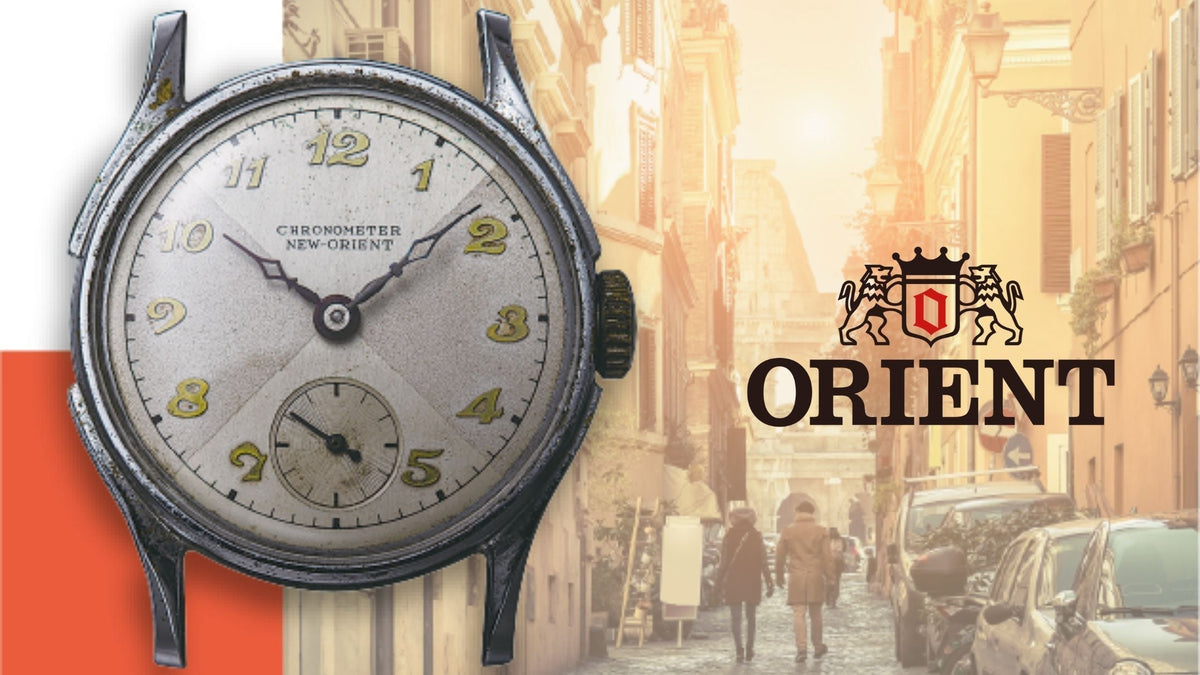
Orient officially began on 13 July 1950, when the company started producing wristwatches from the former Toyo Tokei Co., Ltd. factory in Hino, Japan. It was an established watchmaking site rather than a business starting from an empty building, and production began in the same year. The first mass-produced watch was the New Orient, before the company became Orient Watch Co., Ltd. the following year.
Orient Star also arrived very early in the story. Introduced in 1951, it was created as the more elevated mechanical side of Orient and still holds that position today. From the beginning, there was already an ambition to make more than straightforward everyday watches.

Royal Orient Sets the Ambition
By the end of the 1950s, Royal Orient sat at the top of the company's range. The original Royal Orient was created as a flagship mechanical watch, putting more emphasis on quality, performance and construction than Orient's everyday models. Decades later, the name was important enough for Orient to bring it back. An official Orient release describes the original as a 1959 flagship and confirms that Royal Orient was revived as the company's highest-grade mechanical line in December 2004.
The revived watches were not simply given an old name. Orient had established its Orient Technical Center in Akita in 2003, bringing specialist watchmaking skills together to produce watches designed to be maintained and worn for a long time. Royal Orient is no longer part of the current collection, but its place in the story matters. Orient's reputation for value did not stop it exploring what it could do much further up the mechanical watchmaking ladder.


1960s: Light-Up Dials, 100 Jewels and an Unusual Calendar
The 1960s show a much more experimental Orient. The Orient Flash used miniature bulbs to illuminate the entire dial when the wearer pressed a button at 2 o'clock. It was an ambitious idea with one fairly obvious weakness: the original case was not water resistant. Production ended, the concept was later reworked, and the Flash eventually became a popular model.
Then there was the Grand Prix 100. Japanese manufacturers were competing over jewel counts at the time, and Orient took its existing 64-jewel Grand Prix all the way to 100 jewels. More useful in the long term was the Multi-Year Calendar, introduced in 1965.
The original hand-wound watch used a dial-based calendar system that covered the years from 1960 to 1981. Orient later converted the concept to automatic winding, and by 1976 a version using semi-automated metal calendar plates had become popular internationally. Orient kept coming back to the idea. Modern Multi-Year Calendar watches are still available today, making this one of the clearest links between the Orient of the 1960s and the watches customers can buy now.

From 40m to 1,000m
Orient was also building sports watches surprisingly early. In 1964, the Olympia Calendar Diver became the company's first diver's watch. It offered 40 metres of water resistance and used a hand-wound movement. The Calendar Auto Orient Diver followed, switching to an automatic movement and changing the hands and bezel.
A year later came the original Weekly Orient King Diver, using a compressor-style case and automatic Calibre 660. Despite the name, water resistance was still only 40 metres. Then Orient took a rather large step. By 1969, the King Diver 1000 offered 1,000 metres of water resistance, together with a soft-iron inner case to improve its resistance to magnetism.
Going from 40 metres to 1,000 in around five years says quite a lot about how quickly Orient was willing to push an idea once it became interested in it. Today's Mako and M-Force are very different watches, but Orient's sports-watch history goes back much further than either name.

At 3.9mm, the Fineness Lives Up to Its Name
Not everything was getting tougher or more complicated. In 1967, Orient went in the opposite direction with the Fineness. Inside was the Calibre 3900 series, measuring just 3.9mm thick. Orient says it was, at the time, the world's thinnest self-winding movement to include both day and date displays. It achieved that by changing the layout of the wheel train and using a compact reversing mechanism. The result was a remarkably slim automatic dress watch.
It is an important watch because it shows another side of Orient's engineering. The company was not only interested in adding more functions or increasing capability. Sometimes the challenge was fitting everything into less space.

1970s: The Movement Behind Modern Orient
One of the most important Orient developments is far less obvious from the outside. In 1971, the company introduced its Calibre 46 series. The new movement was smaller and thinner than what came before, giving Orient much more freedom to use it across different types of watch. It also adopted a Magic Lever winding system to improve automatic winding efficiency.
More than five decades later, Orient still describes the 46 series as the foundation of its primary mechanical movement family. After Orient became part of Seiko Epson, the architecture continued to be developed with improvements to finishing, accuracy and functionality. That gives a little more context to the phrase in-house movement when it appears on a modern Orient product page. The movements have changed substantially, but the company has been developing this mechanical family since 1971.

When Orient Got More Experimental
If the Fineness showed restraint, the Jaguar Focus did not. Introduced in 1970, it came from Orient's belief that the growing popularity of colour in other consumer products would eventually reach watches too. The result was a two-tone gradient dial viewed through a nine-faceted crystal that made the colours appear even stronger.
Then came TouchTron in 1976. Developed around an LED module, the display stayed dark until the wearer touched the case. Orient describes it as the world's first watch to activate an LED time display in this way. A later TouchTron II changed the system to button activation. It is a long way from the image many people have of Orient today. But that's exactly why these watches belong in the story. Orient's history is not just a succession of sensible three-hand automatics. Colour, electronics, unusual complications and slightly strange ideas have been appearing for decades.

1990s: Putting the Movement on Show
By 1991, Orient was making the mechanical movement itself part of the design. The Mon Bijou used a full skeleton layout, opening the dial and allowing the mechanics underneath to become the main visual feature of the watch. Orient's own Orient Star heritage material includes it as an important milestone in the development of its skeleton watchmaking. That idea would keep developing.
In 2018, Orient introduced a Semi-Skeleton model using a 46-type F6 movement. Rather than opening the whole dial, only part of the mechanism was exposed, giving the wearer a view of the movement without turning the watch into a full skeleton design. It is a direct line into part of the current Orient range. Semi Skeleton watches can feel like a modern way of introducing customers to mechanical watchmaking, but Orient has been putting its movements on display for decades.

M-Force Turns Up the Strength
In 1997, Orient introduced the first M-Force. This was the tougher side of the range: strong cases, high legibility and a design centred on practical sports-watch use. It was also the first Orient to use pure titanium for both its case and bracelet. The collection continued to develop, eventually becoming a 200-metre diver conforming to Japanese JIS standards in 2011.
The current Orient M-Force watches are bolder and more modern, but the principle is familiar: take an Orient automatic movement and put it into something designed to handle more demanding use.

2004: Three Movements and the Birth of the Mako
Few years sum up Orient quite as well as 2004. At one end was the Mechatronics. This 50.5mm limited edition contained three separate self-winding Calibre 55-series movements, allowing three time zones to be displayed independently. A world-time ring helped the wearer read time around the globe, and only 999 examples were produced. It was large, complicated and mechanically unusual.
In the same year, Orient launched something much more straightforward.
The watch was officially described as the Orient Diver Design, pairing an automatic movement with 20-bar water resistance and a design intended to work just as well for everyday wear. It was not an ISO-standard dive watch, but it provided the foundation for one of Orient's most familiar modern names.

Why is Orient Mako called Mako?
Well, it's not meant to be called Mako. A dolphin was engraved on the caseback of the 2004 watch. According to Orient, people mistook it for a shark and the watch picked up the nickname Mako, a Māori word for shark. The name stuck.
Twenty years later, Orient released a dedicated Mako 20th Anniversary model, by which point an unofficial nickname had become one of the defining names in the collection. It is a fittingly accidental origin for a watch that has gone on to become such a recognisable part of the brand.

2012: The Orient 'Bambino'
Another famous Orient name came from customers. In 2012, Orient introduced the Classic and Simple Style. The ingredients were straightforward: a traditional dial, slender lugs, a delicate case and domed glass that gave the watch a distinctly retro feel. People started calling it the Bambino. Like Mako, the nickname became so closely associated with the watch that it eventually became part of the collection's identity.
The Bambino has changed considerably since then. There are different dial layouts, sizes, colours, complications and movements, but the basic reason it works has stayed fairly consistent. It makes the character of a traditional mechanical dress watch easy to get into.

2017: Orient Joins Seiko Epson
In 2017, Orient Watch Co., Ltd. merged with Seiko Epson Corporation. This can occasionally cause confusion because of the Seiko name, but Orient did not simply become another Seiko collection. Orient and Orient Star continue as separate brands with their own designs, collections and movement development. What changed was the wider company structure. Seiko Epson now handles everything from planning through to manufacturing for both brands.
It also gave Orient access to the technology and manufacturing resources of the wider Epson business while allowing the watch brand to continue developing the identity it had built since 1950.

75 Years Later
In 2025, Orient had reached its 75th anniversary. One of the watches chosen to mark it was a limited-edition Stretto, using a nuanced grey dial and distinctive polished surfaces around the lugs. It is a very different watch from the New Orient of 1950, but it fits neatly into the wider story: a mechanical watch with enough familiar design to be easy to wear and enough individuality to stop it feeling generic. The same is true across much of the modern range.
The Multi-Year Calendar continues an idea that first appeared in 1965. Semi Skeleton models follow decades of experimenting with visible mechanical movements. M-Force still represents the tougher side of the brand. Mako has grown from a 2004 sports watch with an accidental nickname into a complete collection, while Bambino has become one of the most familiar routes into an automatic dress watch. Underneath many of them is movement architecture descended from the Calibre 46 family introduced more than 50 years ago.
Orient now sells watches in more than 70 countries, but it still puts particular emphasis on its own mechanical movements, reliability and a range that moves between simple dress watches and more functional sports models.

Orient Today
Orient is regularly recommended because of the amount of mechanical watchmaking it offers for the money. That's a fair reason to look at the brand. It is just not the only one.
Behind the Bambino, Mako and the watches people know today is a company that has built 1,000-metre divers, ultra-thin automatic movements, touch-sensitive LED watches, skeletons, unusual calendars and even a watch powered by three separate automatic movements. Some ideas lasted. Others very definitely didn't. But that willingness to try them is part of the appeal.