What Is Luminox Light Technology?
Luminox watches are best known for visibility.
That is not just a design choice. It is one of the main reasons the brand exists. Many watches use luminous paint on the hands and hour markers, but Luminox takes a different approach. Its watches use Luminox Light Technology, often shortened to LLT, which is designed to keep the watch visible in low light without needing to be charged by an external light source. For customers looking at Luminox for the first time, this is one of the most important features to understand.
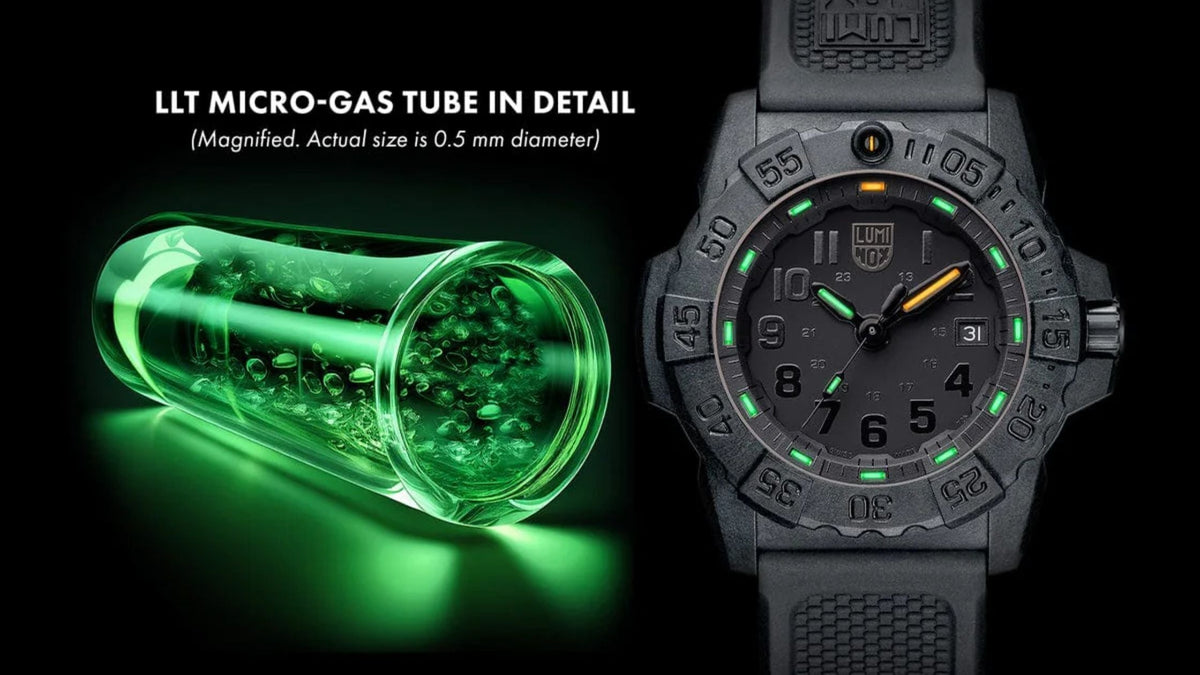
Luminox Light Technology is not the same as standard lume. It is not simply paint applied to the dial. It is a system built around small self-powered light tubes, placed on the hands, hour markers and sometimes the bezel. These tubes are designed to stay visible continuously for up to 25 years.
That matters because most luminous watches need light before they can glow. A watch with standard luminous paint may be very bright just after being exposed to sunlight or a torch, but the glow fades over time. Luminox Light Technology is designed to work differently. It does not need charging, and it does not rely on pressing a button.
This guide explains what Luminox Light Technology is, how it works, how it compares with Super-LumiNova, and why it matters when choosing a Luminox watch.

What is Luminox Light Technology?
Luminox Light Technology is the brand’s self-powered illumination system.
It uses tiny micro gas light tubes to provide constant visibility in darkness or low-light conditions. These tubes are small glass capsules that are fitted to key parts of the watch display, usually the hands and hour markers. On some models, they may also be used on the bezel.
The purpose is simple: to make the watch readable when light conditions change.
On a normal day, this might mean checking the time in a dark room, in the car, on an early morning walk, or during travel. In more demanding settings, it could mean reading the time outdoors, at sea, during night work, or in situations where a light source is not available.
Luminox built much of its identity around this kind of visibility. The brand’s watches are often associated with military, outdoor, diving and tactical use, where being able to read the time quickly can be more than a design preference.
For most customers, the benefit is still practical.
You do not have to remember to charge the lume under light. You do not have to press a backlight button. The watch is designed to remain visible when the surroundings become darker.

How does Luminox Light Technology work?
The system works through small self-powered light tubes.
These are fitted into the watch rather than painted onto the dial. The tubes are usually positioned on the hour markers and hands, because those are the areas needed for reading the time. Some Luminox watches also use light tubes on the bezel, which can help with timing functions or orientation in low light.
The important point is that the light source is built into the watch.
Traditional luminous paint works by absorbing light and then releasing it gradually. That is why it needs to be exposed to natural or artificial light first. Luminox Light Technology does not work in the same way. It is self-powered, so it can glow without needing that external charge.
This makes the experience different from wearing a normal luminous watch.
With standard lume, brightness depends on how recently the watch was exposed to light. With Luminox Light Technology, the aim is consistency. The watch remains readable across changing conditions, rather than giving a bright glow at first and then fading away.
That is why Luminox often describes the system around constant visibility rather than temporary brightness.

Luminox Light Technology vs standard lume
Many watches use luminous material on the hands and markers. The most common system is a light-charged luminous paint, such as Super-LumiNova.
Super-LumiNova can work very well. After being exposed to light, it can glow strongly in the dark. It is widely used across modern watches and is especially common on dive watches, field watches and sports watches.
The difference is that it needs charging.
A watch with Super-LumiNova must first absorb light before it becomes visible in darkness. Once the watch moves into low light, the luminous effect begins to fade. Depending on the watch and the amount of material used, that glow may remain useful for several hours, but it is not constant in the same way as Luminox Light Technology.
Luminox Light Technology is designed to avoid that dependency.
It does not need sunlight, artificial light or a torch to activate. It also does not require a button, unlike watches with electronic backlights. That means it does not use battery power in the way a backlight does.
For the wearer, the difference is straightforward.
A standard luminous watch glows after being charged.
A Luminox watch with LLT is designed to remain visible without being charged.
That is the main reason the technology matters.

Is Luminox Light Technology brighter than Super-LumiNova?
Not necessarily in every situation.
This is a useful distinction.
A freshly charged Super-LumiNova watch can be very bright at first. In some cases, it may appear brighter than Luminox Light Technology immediately after exposure to strong light. But that brightness gradually fades.
Luminox Light Technology is more about consistency than a short burst of brightness.
The benefit is not that it always creates the strongest glow in the first few minutes. The benefit is that it is designed to remain visible for much longer without needing to be charged.
This is why comparing the two systems only by initial brightness can be misleading.
Super-LumiNova is strong when it has been charged.
Luminox Light Technology is useful because it is always working.
That makes LLT especially practical for people who want predictable low-light visibility without thinking about light exposure.

How long does Luminox Light Technology last?
Luminox Light Technology is designed to provide visibility for up to 25 years.
That does not mean the glow remains exactly the same forever. Luminox states that the intensity is guaranteed for the first ten years, after which brightness can gradually decrease as the energy in the tubes reduces.
For the customer, the important point is that this is a long-term illumination system.
It is not a short-term coating that fades after a night of use. It is built into the watch as part of the display. Over time, the tubes may become less bright, but the system is designed around years of visibility rather than hours.
This is one of the reasons Luminox has such a specific position in the watch market.
Many brands can make a watch legible in daylight. Many can make a watch glow after it has been exposed to light. Luminox focuses on watches that remain readable in low light over long periods.

Where are the light tubes placed?
The exact layout depends on the model, but the light tubes are usually fitted to the hands and hour markers.
That is the most important placement because it allows the wearer to read the time. The hour markers show orientation around the dial, while the hands show the current time.
On some watches, Luminox also places tubes on the bezel. This is especially relevant on dive-inspired or timing-focused models, where the bezel may be used to measure elapsed time.
Placement can affect how the watch reads in darkness.
A simple three-hand watch may only need markers and hands. A more technical model may use additional tubes to make the bezel or specific timing points easier to see.
This is worth checking when comparing Luminox watches. Not every model will use the exact same tube layout, and some will offer more detailed low-light orientation than others.

Why does LLT matter on a tool watch?
A tool watch should be easy to read.
That sounds obvious, but it is one of the most important parts of watch design. If a watch is built for outdoor use, diving inspiration, field wear, tactical style or everyday utility, legibility matters.
Luminox Light Technology supports that by making the watch usable in a wider range of conditions.
A watch can have a strong case, good water resistance and a durable strap, but if it becomes hard to read when light drops, it loses part of its practical value. Luminox solves that problem by making visibility one of the central features of the watch.
This is especially relevant across collections such as Navy SEAL, Pacific Diver, Bear Grylls, Leatherback Sea Turtle and other Luminox models built around active or outdoor use.
The technology is not there only for appearance. It changes how the watch functions in real use.

Does Luminox Light Technology need a battery?
No, the light tubes themselves do not need the watch battery to glow.
This is an important advantage over watches with electronic backlights. A digital watch with a backlight uses battery power when the light is activated. Luminox Light Technology does not rely on a button or the watch battery for its glow.
That does not mean the watch itself does not need power.
Many Luminox watches use Swiss quartz movements, which are powered by a battery. The movement needs that battery to keep time. But the LLT tubes are self-powered separately from the movement.
So the simple answer is:
The watch movement may need a battery, but the Luminox Light Technology does not need the battery to illuminate the dial.

Is Luminox Light Technology safe?
Luminox states that its micro gas light tubes are safe for humans and the environment.
The tubes are small sealed capsules, and Luminox says they are installed by hand into every watch. The brand also describes a quality-control process that includes checks for brightness, dimensions, thermal shock, leakage, pressure and vibration effects.
For customers, the key point is that the tubes are a sealed part of the watch construction.
As with any watch, the sensible advice is to avoid opening or damaging the case unnecessarily. If a watch needs servicing or repair, it should be handled by an appropriate service professional.
In normal use, LLT is designed to be a safe and practical visibility system.

Luminox Light Technology vs a digital backlight
A digital backlight is different from Luminox Light Technology.
A backlight uses electricity to illuminate the display when a button is pressed. This can be useful, especially on digital watches, but it is temporary. It also depends on battery power and requires the wearer to activate it.
Luminox Light Technology is passive from the wearer’s point of view.
There is no button to press. The tubes are already visible in low light. That means the watch can be read quickly, without changing grip, reaching for a control or using additional battery power.
This is one of the reasons LLT fits analogue tool watches so well.
It gives the watch low-light legibility while keeping the experience simple.
Who benefits from Luminox Light Technology?
Luminox Light Technology is useful for anyone who wants a watch that remains readable in darkness or low light.
That includes:
people who work early mornings or nights
outdoor users
travellers
drivers
campers
divers and watersports users
people who want a highly legible everyday watch
customers choosing a Luminox for its military or tactical character
It is also useful in normal daily life.
You do not need to be in extreme conditions to benefit from better visibility. Checking the time in a dark bedroom, during a journey, in a cinema, on an evening walk or in poor weather is enough to understand why constant illumination can be useful.
The appeal is practical rather than complicated.
The watch is easier to read more often.