

Nivada Grenchen Expands the Autochron with 5 New References
The Nivada Grenchen Autochron has always been a slightly unusual chronograph.
Its story begins with a watch that never really made it into production. Developed during the 1970s, the original Autochron is believed to have existed in only around 20 prototype examples, combining a racing-style chronograph dial with a rotating bezel, date display and the sort of water resistance more commonly associated with a sports or dive watch. Nivada revived that design in 2024, first with a mechanical Valjoux 7750 movement and later with a more accessible mecaquartz version.
Now the collection is getting bigger.
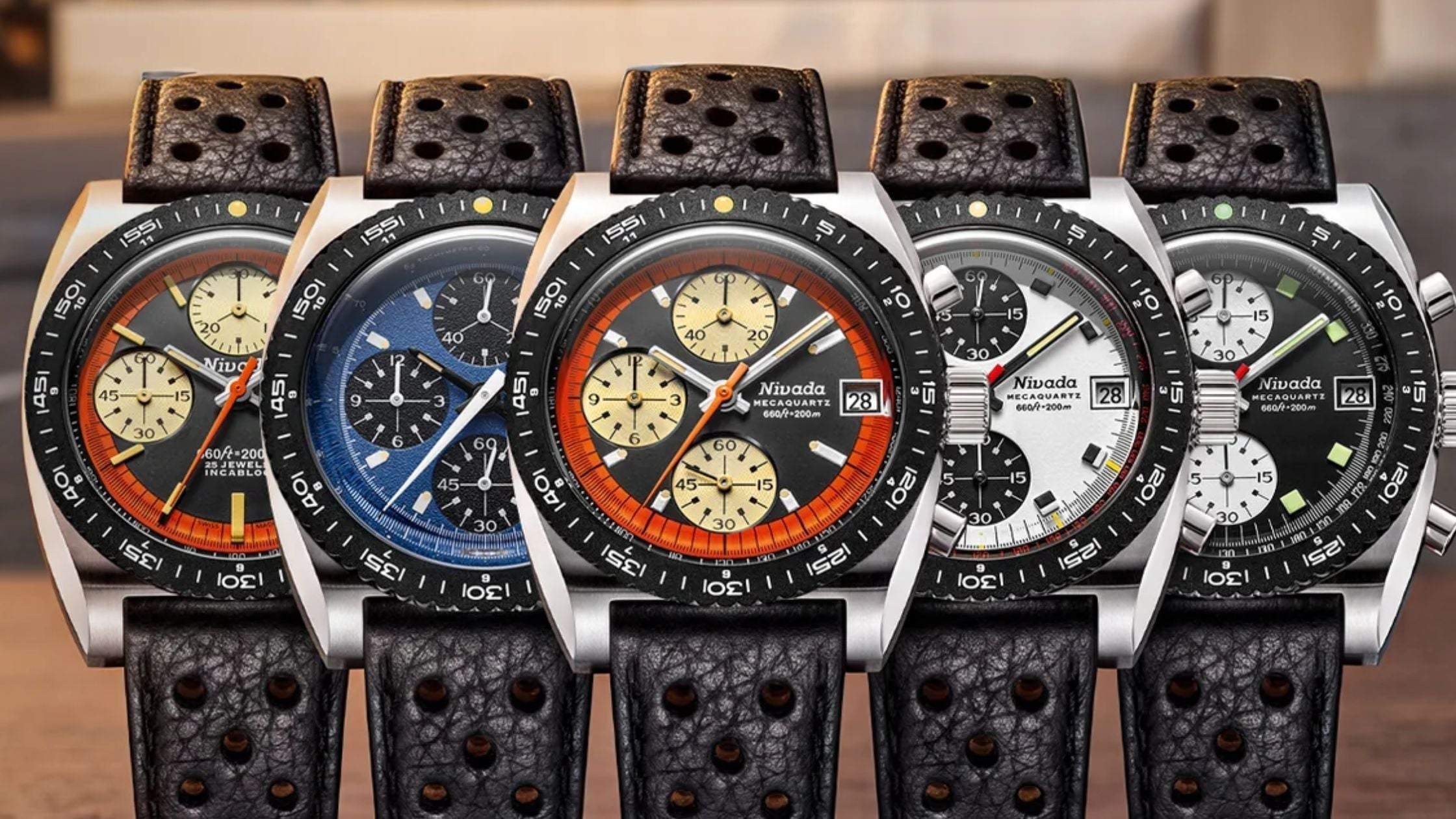
Five new Autochron references have arrived, led by an Automatic Orange, alongside Mecaquartz Orange, Blue, Panda and Reverse Panda versions. The colours are the obvious change, but there is more going on here than a new set of dials. Nivada has also changed the bezel, broadened the choice between mechanical and hybrid movements and given the Autochron a much clearer identity as a complete collection rather than a single vintage revival.

From a 1970s Prototype to a Proper Collection
The history is part of what makes the Autochron interesting. The original was developed as a multi-sport chronograph, designed to bridge motorsport and diving. That explains some of the unusual decisions around the watch. There is a tachymeter scale and chronograph functionality for timing, but also a rotating external bezel and a case designed to cope with water.
The dial has another layer of history. Nivada connects the original Autochron design with Singer, the Swiss dial manufacturer whose work appeared on some of the best-known chronographs of the period. The Autochron carries the sort of contrasting sub-dials, unusual typography and strong use of colour associated with that era, without simply looking like another conventional racing chronograph.
When Nivada brought the Autochron back in 2024, it kept much of that character intact. The 38mm case was deliberately compact by modern chronograph standards, while a double-domed sapphire crystal, 200 metres of water resistance and the ETA Valjoux 7750 brought the specification up to date. The mecaquartz version followed with the same basic idea at a very different price point.

A New Orange Autochron Leads the Range
The Autochron Automatic Orange is the mechanical centrepiece of the new collection. Orange is not being used as a small accent here. The colour dominates the dial and immediately gives the Autochron a much stronger 1970s racing feel, particularly against the darker bezel and contrasting chronograph counters. Nivada describes the combination as signal orange with gilt counters and a black racing bezel, and it is easily the most visually assertive version of the five new watches.
Underneath it still the ETA Valjoux 7750, one of the most established automatic chronograph movements in Swiss watchmaking. It runs at 28,800 vibrations per hour and provides the proper mechanical interaction expected from an automatic chronograph, including the familiar positive action from the pushers and a central chronograph seconds hand. Nivada has already used the 7750 throughout the revived automatic Autochron range, so the Orange is building on a proven mechanical platform rather than introducing a new movement simply for the sake of it. What changes is the personality.
Previous Autochron references have generally allowed the structure of the original dial to do most of the work. Orange makes the watch feel much more obviously connected with the paddock and racing chronographs of the 1970s. It is not subtle, but the Autochron has never really been a subtle design.

Four New Mecaquartz Versions
The bigger expansion happens on the mecaquartz side. There are now Orange, Blue, Panda and Reverse Panda options, all powered by the TMI VK67.
Mecaquartz makes particular sense in a chronograph like this because it sits somewhere between a conventional quartz watch and a fully mechanical chronograph. Quartz handles the underlying timekeeping, while the chronograph mechanism gives the central timing hand a smoother action and an instant reset that feels closer to operating a mechanical chronograph.
The VK67 also gives the mecaquartz Autochron three sub-dials rather than the two-register layout used by the Valjoux-powered automatic. It includes running seconds alongside chronograph minute and hour counters, so there is a genuine visual difference between the two versions rather than the movement simply being changed behind an identical dial.
That gives customers a fairly straightforward choice. The automatic is for someone who specifically wants a mechanical chronograph and everything that comes with the Valjoux 7750. The mecaquartz models keep much of the same design and functionality while being easier to own and considerably more accessible. Neither has to pretend to be the other.

Five New Dials, Five Different Characters
The latest Autochron release gives the collection five new references, and each one changes the character of the watch in a noticeable way.
The Automatic Orange is the standout. Its bright orange dial, gilt-toned counters and black bezel give the Autochron a much stronger 1970s racing feel, while the Valjoux 7750 keeps it firmly at the mechanical end of the collection.
The Mecaquartz Orange takes the same colour direction and brings it to the VK67-powered range. It keeps the impact of the automatic version, but with the lower-maintenance, more accessible character of a mecaquartz chronograph.
The Blue is more restrained. There is still plenty happening across the dial, but the cooler colour makes the Autochron feel slightly calmer and easier to wear day to day without losing the busy, technical layout that defines the collection.
The Panda moves into more familiar chronograph territory, pairing a light dial with contrasting dark sub-dials. It is a classic motorsport combination and works particularly well with the Autochron’s three-register layout, giving the dial plenty of contrast without making it feel overly complicated.
The Reverse Panda flips that arrangement, using a darker main dial with lighter counters. It has a stronger vintage feel and sits closest to the darker, more purposeful character associated with earlier Autochron designs.
There is quite a bit of variety here without changing the basic watch. Orange is the boldest, Blue is the most understated, Panda feels the most traditionally motorsport-inspired and Reverse Panda leans further into the Autochron’s vintage side. The choice between Automatic Orange and Mecaquartz Orange then adds another decision: whether the movement matters as much as the colour.

The Bezel Has Changed Too
One of the most useful changes is also one of the easiest to miss in photographs. Earlier Autochron models used a bidirectional rotating aluminium bezel without the defined clicks we associate with most modern sports watches. It suited the vintage recreation, but the action was deliberately quite simple.
The new collection replaces that with a 120-click unidirectional bezel with an aluminium insert. Nivada has specifically focused on the more positive, tactile action of the new system. That matters because the bezel is a real part of the Autochron's character.
This has always been a slightly strange meeting point between a racing chronograph and a water-capable sports watch. Giving the bezel 120 defined positions makes it more satisfying to use, but it also makes that practical side of the watch feel more convincing. The 200-metre water resistance remains too. It is considerably more capability than most people expect from a vintage-inspired racing chronograph and means the Autochron does not have to be treated like something delicate just because its design comes from the 1970s.

Still 38mm, and That Matters
Nivada has resisted making the new Autochron unnecessarily large. The collection retains a 38mm stainless steel case, with Nivada listing a 44.3mm lug-to-lug measurement and 20mm lug width. There is also a double-domed sapphire crystal, applied Super-LumiNova on the hands and indexes and an embossed caseback marking Nivada's 1926 founding year. Thirty-eight millimetres is an important part of why this design works.
There is a lot happening on an Autochron dial. Between the chronograph counters, tachymeter markings, date and external rotating bezel, increasing the case size could easily make the whole watch feel more like a modern instrument than a revival of an unusual 1970s design. Instead, it stays compact enough to retain that period character.
There are three main ways to wear it too: stainless steel bracelet, tropical rubber or racing leather. Each pulls the same watch in a slightly different direction. Racing leather makes obvious sense with the chronograph story, tropical rubber brings out the unusual aquatic side of the Autochron, while steel gives it the most complete sports-watch appearance.

Automatic or Mecaquartz?
The Automatic Orange is clearly for the mechanical enthusiast. The Valjoux 7750 is part of the experience, from the movement of the chronograph hand to the physical feel of operating it. There is also simply something appropriate about putting an established Swiss automatic chronograph calibre inside a watch so heavily influenced by the 1970s.
The VK67 models take a different approach. They are accurate, lower maintenance and make the Autochron design available without the cost associated with a full mechanical chronograph. They still retain a proper 12-hour chronograph counter and the quick mechanical-style reset that gives mecaquartz much of its appeal. Nivada rates the VK67 battery at around three years.
For some customers, the movement will decide the watch immediately. For others, the dial probably will. That is what makes this latest release more interesting than simply adding another Autochron reference.

The Autochron Finally Feels Like a Family
The original Autochron was an obscure prototype. The 2024 revival gave collectors the opportunity to actually own the design. The first mecaquartz version then made it considerably easier to access.
These five new references are the point where the idea starts to feel complete.
There is now a mechanical flagship in Orange, four distinct mecaquartz personalities and enough choice in straps and bracelets to move the watch between its racing and sports-watch sides. The new 120-click bezel improves something you can physically interact with, rather than simply changing the colour of the dial, while the 38mm proportions and unusual Autochron layout remain intact.
And that is probably the right way for Nivada to develop a watch like this.
The Autochron became interesting because it was different in the first place. Making it more conventional would lose the point.
The new Nivada Grenchen Autochron references give that strange 1970s formula more choice, more colour and a better bezel, without tidying away the character that made it worth reviving.
The latest Nivada Grenchen Autochron models are available at WatchNation.


Leave a comment
This site is protected by hCaptcha and the hCaptcha Privacy Policy and Terms of Service apply.