

Hamilton Khaki Field Auto "The Odyssey": A Movie Watch Does Not Need to Be in the Movie
Film watches usually work in one of two ways.
Some are props first. They appear on screen, become part of the story and, if the watch world is paying attention, take on a second life once the credits roll. Others are commercial tie-ins, made around a film rather than for it. The risk with the second type is obvious: too much branding, too much packaging, not enough watch.
The Hamilton Khaki Field Auto The Odyssey Limited Edition sits somewhere more interesting.
It is tied to Christopher Nolan’s upcoming adaptation of The Odyssey, but it does not appear to be trying to solve the impossible problem of putting a wristwatch into ancient Greece. That would have been strange. Homer’s world is not one of automatic movements, sapphire crystals and leather straps with pin buckles.
Instead, Hamilton has taken the more sensible route. It has used the world of the film as a design brief, then built the watch around one of its strongest existing platforms: the Khaki Field Auto.
That is why this works.
The watch does not need to pretend it belongs in the story. It simply borrows enough from the story to become more interesting.

The brief: ancient story, modern watch
The starting point here is important.
The Odyssey is one of the oldest and most enduring stories in Western literature, set in a world long before mechanical timekeeping, let alone wristwatches. That makes this a very different kind of Hamilton film collaboration from something like Interstellar, where the Murph could exist naturally within the film’s world, or Tenet, where the watch became part of the plot’s technical language.
With The Odyssey, the watch has to do something else. It has to carry references, not serve as a prop.
That sounds simple, but it is where many film-linked watches lose their way. The temptation is to make everything obvious: logos, colours, quotes, oversized packaging and a dial that explains itself too loudly.
Hamilton has avoided most of that. The result is still clearly a collector’s piece, but the watch itself remains recognisably a Khaki Field. The case shape, legibility, automatic movement and practical proportions are all still there. The references sit on top of that foundation rather than replacing it.
That matters because the Khaki Field is not a blank canvas by accident. It is one of Hamilton’s clearest modern watch families, built around military and field-watch language: easy to read, functional, straightforward and hard to overcomplicate. For a film watch inspired by a story of travel, endurance and return, that base makes more sense than a dress watch or a purely decorative limited edition.

Why bronze?
The most immediate change is the case.
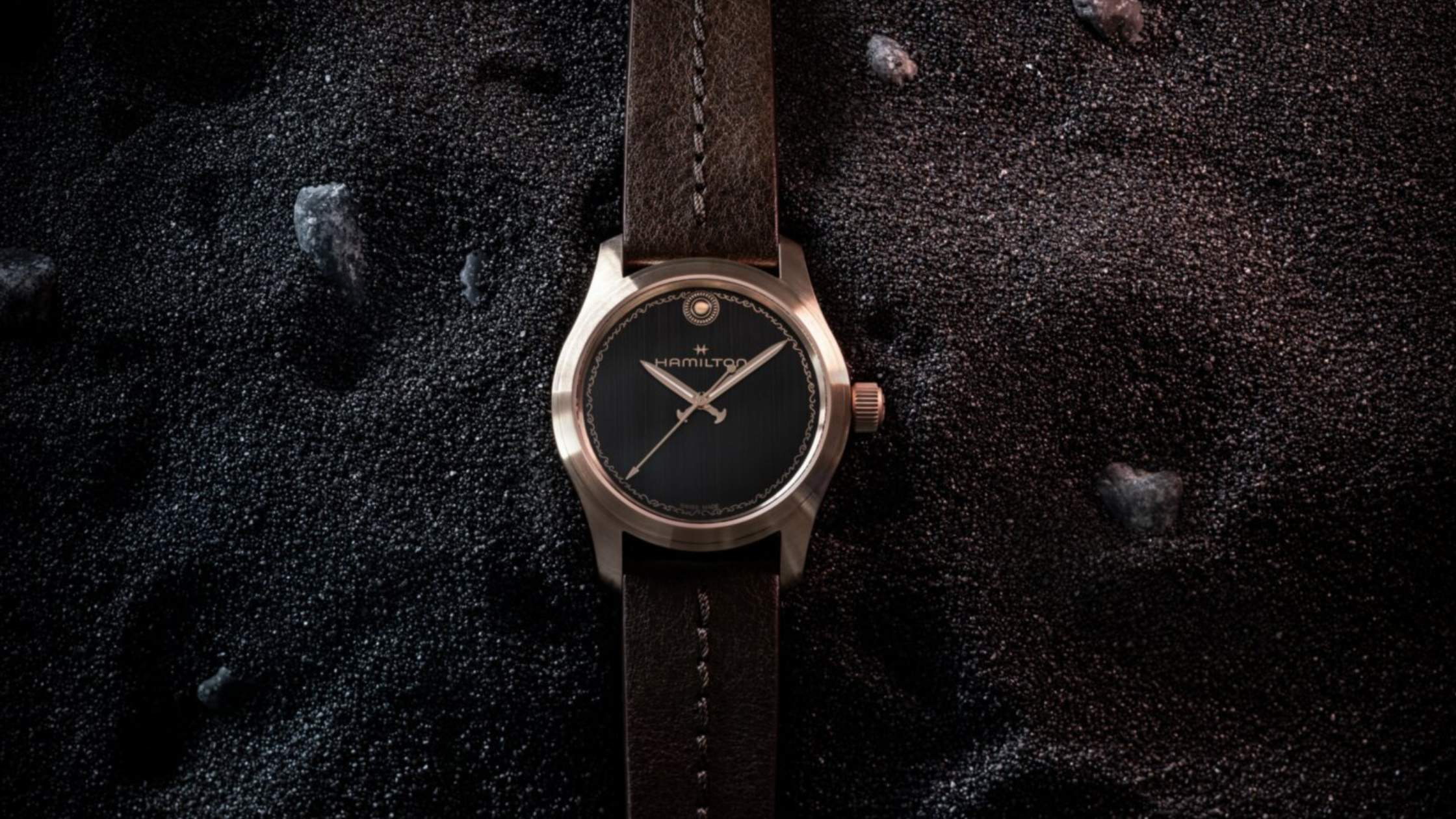
This limited edition uses a 42mm bronze case, which gives the watch a very different feeling from a standard steel Khaki Field Auto. Bronze is warmer, less neutral and more likely to change with wear. Over time, it will develop its own patina depending on how the watch is used, handled and exposed to the environment.
That ageing process suits the idea behind the watch.
A bright, polished steel case would probably feel too clean for the source material. Bronze gives the watch a more ancient quality without forcing it into costume territory. It hints at age, material history and use, while still being a practical modern watch case.
There is also a neat logic to it. The Odyssey belongs to a world associated with the Bronze Age, so the material choice is not random. It is one of the more restrained ways Hamilton could have connected the watch to the setting without writing the theme too loudly across the dial.
The size is worth mentioning too. At 42mm, this is not the smallest Khaki Field, but the watch remains relatively slim at 10.9mm. That helps keep it wearable, especially for a case material and dial treatment with this much character. A bronze limited edition already has presence. It does not need excessive thickness to make the point.

A dial built from symbols, not logos
The dial is where the watch becomes more specific.
Hamilton has used a black dial with bronze-coloured detailing, giving the watch a darker, more cinematic feel than a standard field watch. The outer dial pattern is inspired by Odysseus’ helmet, while the 12 o’clock marker references a rivet from the hero’s sword scabbard. The hands also follow the same idea, with sword-shaped hour and minute hands and a seconds hand that reads more like a spear than a standard field-watch pointer.
This is the sort of detail that could easily become too literal, but the overall effect is cleaner than it sounds on paper. There is no huge film logo across the dial. The watch does not rely on a title treatment to explain itself. Instead, the references are built into the shapes and textures.
That is the better approach.
The watch needs to stand on its own once the film connection becomes less new. A dial covered in obvious branding might work for a launch window, but it dates quickly. Here, the story is present if you know what you are looking at, but the design still functions as a watch first.
That is probably the most important line with any collaboration piece: does it still work when you remove the press release?
In this case, yes. A bronze Khaki Field Auto with a black dial, sword-style hands and a more decorative outer track would still make sense even without the film around it. The Nolan and Odyssey connection adds context rather than doing all the work.

The caseback carries the collector detail
The back of the watch is more direct.
Hamilton has fitted a brushed titanium caseback engraved with Odysseus’ helmet and Christopher Nolan’s signature. That feels like the right place for the more explicit collector element. It keeps the dial cleaner, while still giving the watch a clear link to the collaboration.
The use of titanium is also practical. Bronze can react against the skin for some wearers, so bronze watches often use a different metal on the caseback. Here, the titanium caseback helps with wearability and gives Hamilton a surface for the engraving.
It is also a reminder that this watch is not only aimed at people who want a bronze field watch. It is aimed at Hamilton collectors, Nolan fans and people who like the way cinema and watchmaking occasionally overlap.
That audience will care about the caseback. They will care about the signature. They will care that the watch feels tied to the film beyond a colourway.
But again, the detail is contained. It does not take over the whole watch.

Still a proper Khaki Field underneath
The film connection is the hook, but the underlying specification is part of why the watch holds together.
Inside is Hamilton’s H-10 automatic movement, with an 80-hour power reserve and a Nivachron balance spring. That gives the watch a practical advantage in normal use. You can take it off for a couple of days and come back to it without immediately needing to reset the time.
The watch also has sapphire crystal, anti-reflective treatment, Super-LumiNova and 100m water resistance. Those are the details that keep it grounded as a field watch rather than turning it into a display object.
That is important because limited editions can sometimes lean too far into being collectible and not far enough into being wearable. This one should still make sense as a watch you can actually use. The bronze case may age, the leather strap may soften, and the dial will remain the part you look at most, but the specification underneath is not fragile.
It is a collector’s piece, but not a precious one.
That feels right for Hamilton.
The brand has always been strongest when its cinematic watches still feel like real watches. The Murph worked because it was a good field watch even before you cared about Interstellar. The Tenet connection worked because Hamilton understood that the watch had to feel functional within the world of the film. This Odyssey edition follows the same basic rule: the story matters, but the watch has to justify itself on the wrist.

The number: 2,112 pieces
The Hamilton Khaki Field Auto The Odyssey Limited Edition is limited to 2,112 pieces.
The number is not arbitrary. Hamilton connects it to the recurring significance of 12 in Greek mythology, while wider coverage has pointed to references including the 12,000 lines of the poem, the 12 ships taken to Troy and the 12 axe heads in Odysseus’ return to Ithaca.
Limited-edition numbering can sometimes feel like a marketing afterthought, but here the number at least belongs to the theme. It also keeps the watch in an interesting place. It is limited, but not so restricted that it becomes purely theoretical for most buyers. There are enough pieces for the watch to exist in the real world, but not so many that the collector angle disappears.
That is a useful balance.
Too few pieces and the watch becomes a headline more than a product. Too many and the word limited starts to mean very little. 2,112 gives Hamilton room to reach both film fans and watch buyers without making the edition feel completely open-ended.

The set around the watch
Hamilton has also built the presentation set around the film.
The watch comes with a replica Athena pin, connected to the film’s story, along with a collector-style box and commemorative elements. This is the part of the release that feels most obviously aimed at the film audience, and that is not a problem.
A collaboration like this should offer more than the watch alone. The key is not letting the extras compensate for a weak design. Here, they do not need to. The watch already has enough reason to exist, so the set becomes an extension of the idea rather than the main attraction.
That matters for long-term appeal. Packaging can make the first experience feel more special, but it is not what someone wears. The watch still has to carry the collaboration day after day.

Why this collaboration feels different
Hamilton and Christopher Nolan have built one of the more interesting ongoing relationships between watches and film.
Not because every release is the same, but because each one has dealt with the problem differently. Interstellar gave the Murph a direct emotional role. Tenet needed something more technical and plot-driven. Oppenheimer used period-correct vintage Hamilton watches to support the world of the film.
The Odyssey could not really follow any of those routes.
A watch in ancient Greece would not make sense. A screen-worn recreation would not work. A historically accurate prop was not the answer. So Hamilton has created a watch that sits beside the film instead of inside it.
That may be the smarter choice.
It gives the brand room to interpret rather than imitate. The bronze case, dial symbols, caseback engraving and Athena pin all connect to the world of the film, but the watch remains a modern Hamilton. It does not try to become an artefact. It becomes a watch inspired by one.
There is a difference.


Commenta
Questo sito è protetto da hCaptcha e applica le Norme sulla privacy e i Termini di servizio di hCaptcha.