

Article: Suunto Run 2: What's New, What’s in the Box and Everything You Need to Know
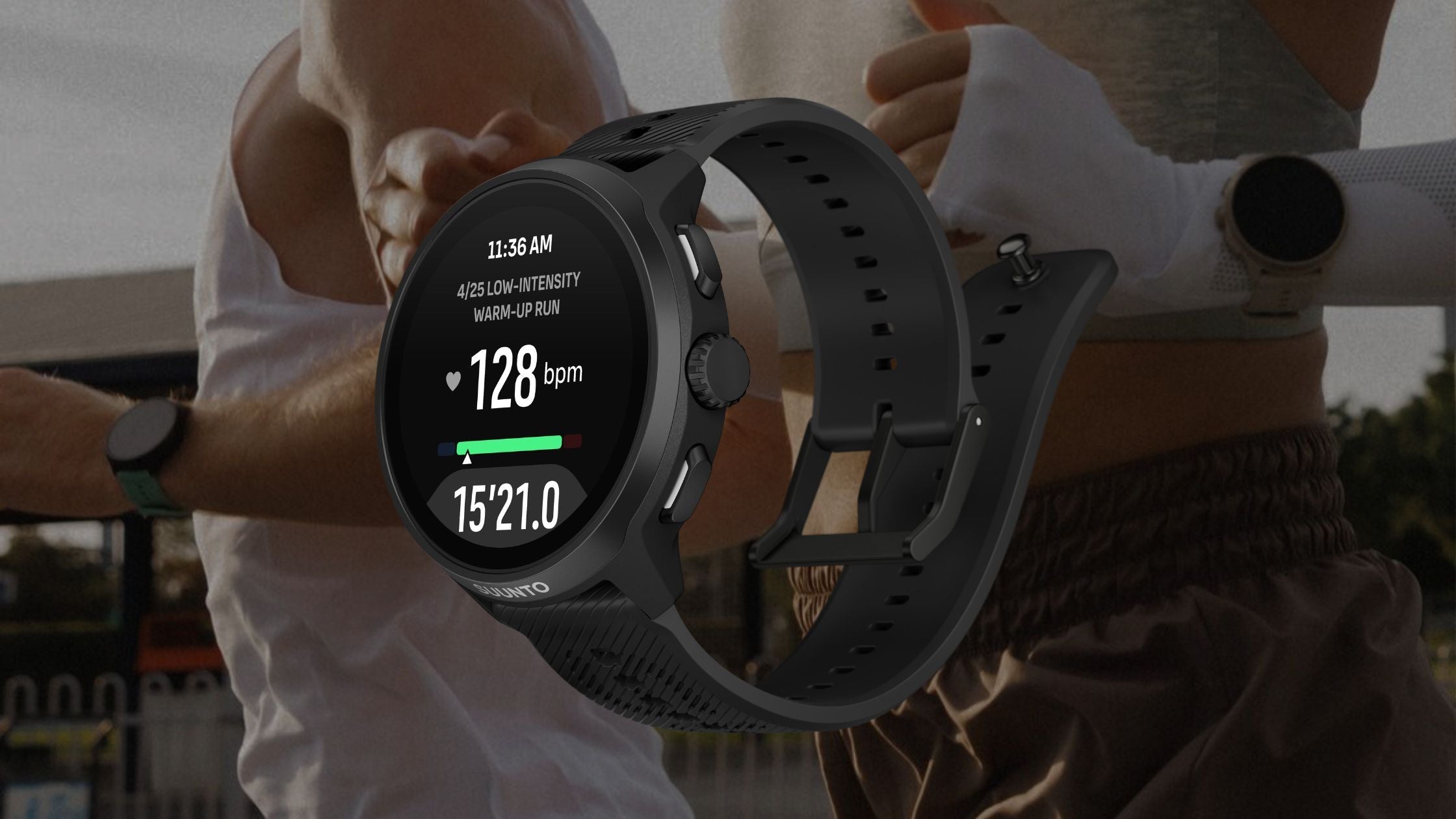
Suunto Run 2: What's New, What’s in the Box and Everything You Need to Know
The original Suunto Run arrived in 2025 with a fairly clear idea behind it. Keep it light. Make running the priority. Give it a bright AMOLED display, dual-band GPS, proper training tools and enough onboard storage to leave the phone behind when you wanted music.
With the Run 2, Suunto has gone back through the original and concentrated on the things that could make the watch more useful over an entire training block: a considerably brighter display, a redesigned heart-rate sensor, more battery capacity, updated satellite positioning and, perhaps most importantly, offline maps.
There is also now a choice of 4GB or 64GB storage, while the launch collection comes in All Black, Aloe Green and Feather Gold. Suunto lists both storage versions across the range, effectively creating six configurations of the same underlying watch.
It is still very obviously a running watch, there is simply in it this time.

Suunto Run 2 at a glance
The headline specifications are:
| Case size | 46.5mm |
| Thickness | 11.66mm |
| Watch body weight | 35g |
| Complete weight with silicone strap | Approx. 53g |
| Display | 1.32-inch LTPS AMOLED |
| Resolution | 466 × 466 |
| Brightness | Up to 2,000 nits |
| Glass | Gorilla Glass |
| Bezel | Stainless steel |
| Case | Glass-fibre reinforced polyamide |
| Water resistance | 5 ATM / 50 metres |
| Strap | 22mm quick-release silicone |
| GPS | Dual-band L1 + L5 GNSS |
| Satellite systems | GPS, GLONASS, Galileo, BeiDou, QZSS |
| Heart rate | New 12-channel optical sensor |
| Offline maps | Yes |
| Offline music | Yes |
| Storage | 4GB or 64GB |
| Dual-band GNSS battery | Up to 24 hours |
| Power-saving GNSS | Up to 40 hours |
| Smartwatch battery | Up to 13 days |
| Sport modes | 35 |
Suunto's headline 35g figure refers specifically to the watch body. With the supplied silicone strap fitted, its own product data gives the complete weight at around 53g. That distinction is worth making, particularly because the original Suunto Run was often advertised at 36g with its lightweight textile strap included.
The point remains the same, though: this is a relatively slim, lightweight sports watch built to spend a lot of time on the wrist.

The shape has barely changed
At first glance, Run 2 looks familiar.
The case remains around 46mm across, with a circular display, three-button layout and central rotating crown. Thickness has moved only slightly from approximately 11.5mm on the original Run to 11.7mm here.
The construction combines a stainless-steel bezel, Gorilla Glass and a lightweight reinforced polymer case, with a 22mm quick-release silicone strap. Water resistance is rated to 5 ATM, making it suitable for running in poor weather and swimming, although Suunto is clear that this is not a dive watch.
There was little reason to make the Run substantially larger or tougher. Its job is not to compete with the much more substantial outdoor watches in Suunto's range. It is supposed to disappear reasonably easily on a wrist while still giving you the information you need when you look down. That leads us to one of the biggest changes.

The display is now way brighter
The screen itself remains 1.32 inches, with a 466 × 466 resolution. Brightness is another matter. The original Suunto Run was rated at around 600 nits. Run 2 increases that to 2,000 nits. That is more than three times the quoted brightness. And this is one of those specifications that makes more sense when you stop thinking about the number.
A running watch is regularly being read outdoors, while your arm is moving, often in direct sunlight. You are not sitting still studying the display. You want to see pace. Heart rate. Distance. Then get your eyes back on where you are going.
A considerably brighter display should make that information easier to take in without having to tilt the watch or shade it with your other hand. The screen was already one of the better parts of the first Run. This time Suunto has given it considerably more headroom.

The heart-rate sensor is a much bigger change
Turn Run 2 over and there is arguably a more interesting upgrade. Suunto has fitted a redesigned 12-channel optical heart-rate sensor behind curved 2.5D sensor glass. The intention is to gather a more consistent optical signal from the wrist as movement and effort change. That matters because wrist-based heart rate was one of the more mixed areas of the original Run.
Early independent Run 2 testing is encouraging too. The5KRunner reported a much more consistent performance from the redesigned sensor across running, cycling, treadmill and other sessions. As always with optical heart-rate measurement, results still vary with the wearer, fit, activity and conditions, but the hardware change itself is significant.
For runners who train by heart-rate zones, that could ultimately matter more than almost anything else on the specification sheet.

Offline maps finally come to the Run
This is probably the easiest upgrade to explain. The original Suunto Run could follow routes. It did not have full offline mapping. Run 2 does.
You can download free worldwide offline maps to the watch and view roads, place names, contours and the surrounding area directly from the wrist without needing a mobile data connection. That changes what the Run can comfortably be used for.
A normal training route around home probably does not need a detailed map.
A run through an unfamiliar city might.
So might a route that leaves the road and joins a trail.
Or simply a long run where you decide halfway through that you would rather get home by a different route.
Route navigation tells you where the planned line goes.
A proper map gives you context around it.
That was one of the most obvious differences between the original Run and Suunto's more expensive mapping watches. Run 2 closes a substantial part of that gap.
4GB or 64GB?
The second-generation model also introduces a storage choice. The standard Run 2 has 4GB, while the higher-capacity version has 64GB. Suunto's current specification describes that storage as being shared between offline maps and music on both versions. So 64GB does not turn it into a fundamentally different watch. It gives you considerably more room.
If you mainly run around the same region, download a modest map area and keep a small amount of music on the watch, the 4GB version may be perfectly sufficient.
If you want to keep much larger map regions available, travel regularly or carry a sizeable offline music library, 64GB gives you far more freedom.
It is a sensible distinction because mapping is exactly the sort of feature that makes storage capacity suddenly relevant. On the original Run, 4GB was predominantly there for music. Run 2 has more things competing for the space.
The battery is larger too
Run 2 moves from a 295mAh battery to 380mAh, an increase of approximately 29% according to Suunto. The easiest improvement to compare is GPS runtime.
The first Run offered around 20 hours in its highest-accuracy dual-band mode.
Run 2 increases that to 24 hours.
-
up to 24 hours with all-systems, multi-band GNSS
-
up to 30 hours using all-systems single-band GNSS
-
up to 40 hours in power-saving GNSS modes
-
up to 13 days in smartwatch mode
With the always-on display enabled during multi-band recording, Suunto lists up to around 18 hours. Battery figures always depend heavily on settings, screen use, GPS mode, heart-rate recording and connected features, so they are better treated as operating ranges than guarantees. But the bigger battery has a clear purpose. More screen brightness, maps and updated sensors all ask more from the hardware. Suunto has increased the capacity alongside them.

Marathon Mode brings the tools together
Suunto also gives Run 2 a dedicated Marathon Mode. It brings race-focused information together rather than making the runner search through unrelated screens. Alongside finish prediction and EnergySense, Suunto highlights tools including Ghost Runner, pacing targets and time or distance targets. Ghost Runner works as a virtual pacer, showing whether you are running ahead of or behind a chosen target.
The watch can therefore tell you more than your current pace.
It can tell you what that pace means in relation to the race you are trying to run.
At kilometre three that may feel unnecessary.
At kilometre 33, doing less mental arithmetic is usually welcome.

Training Plan looks beyond race day
Suunto has also extended the idea further backwards into the training block. Training Plan can take a goal, Suunto gives the example of a sub-four-hour marathon, and translate it into the individual sessions needed to work towards it.
Alongside it, Training Zone brings together training load, HRV, sleep and recovery information so fitness and fatigue can be considered as part of the same picture rather than as isolated numbers.
Again, that suits the underlying Run idea. For training data to be genuinely useful, it needs to understand some of what happens between those runs too.

What has changed from the original Suunto Run?
This is probably the simplest way to understand Run 2.
| Suunto Run | Suunto Run 2 | |
|---|---|---|
| Case | Approx. 46 × 46 × 11.5mm | Approx. 46.5 × 46.5 × 11.7mm |
| Display | 1.32-inch AMOLED | 1.32-inch LTPS AMOLED |
| Brightness | 600 nits | 2,000 nits |
| GPS | Dual-band GNSS | Updated dual-band GNSS |
| Optical HR | Previous-generation sensor | New 12-channel sensor |
| Battery capacity | 295mAh | 380mAh (+29%) |
| High-performance GPS | Approx. 20 hours | Up to 24 hours |
| Offline maps | No | Yes |
| Route navigation | Yes | Yes |
| Storage | 4GB | 4GB or 64GB |
| Offline music | Yes | Yes |
| Marathon tools | Yes | Expanded |
| Water resistance | 5 ATM | 5 ATM |
Suunto's own Run 2 comparison page confirms the main hardware figures, while the original Run product page confirms that features such as dual-band GPS and offline music were already present on the first generation.
So the biggest additions are not difficult to identify.
Maps.
A much brighter display.
A redesigned heart-rate sensor.
A larger battery.
More storage.
The GPS is updated rather than newly dual-band, and much of the core running philosophy remains intact.
That is probably the right way to evolve the Run.

What comes in the box?
The supplied Run 2 packaging is pleasingly straightforward.
Inside you get:
1. Suunto Run 2
The watch itself, with the chosen case and colour configuration.
2. Suunto Athletic 6 22mm silicone strap
The two strap sections are supplied separately in the packaging and attach using the quick-release system. Suunto lists the supplied strap as an S/M size.
3. USB-C charging cable
A magnetic charging puck connects to the back of the watch, with USB-C at the other end.
4. Quick Guide
Enough to get the watch started and paired.
5. Product safety, regulatory information and international warranty documentation
That matches the presentation shown in the launch packaging: watch head, strap sections, magnetic charger and printed documentation are all laid out separately rather than arriving already assembled.
The Run 2 range
At launch, Suunto is presenting Run 2 in three colourways:
Aloe Green
The most obviously sporting of the three.
The mint-green silicone strap gives it considerably more presence than the black version without making the watch itself difficult to read.
All Black
The straightforward option.
Black case, black strap and the least conspicuous version to keep on the wrist beyond training.
Feather Gold
The softer alternative, moving the Run away from the usual all-black sports-watch formula.
Each is offered with either 4GB or 64GB storage, giving the launch range six configurations in total.
The watch underneath remains fundamentally the same.
The real decision is how much storage you expect maps and offline audio to consume.


Leave a comment
This site is protected by hCaptcha and the hCaptcha Privacy Policy and Terms of Service apply.